
Warehouse Management Software
Run every warehouse with precision.
A mispick is a return, a refund, and a 1-star review. Linnworks brings barcode scanning, wave picking, and efficient routing into one warehouse management system, connected to every channel you sell on.
Trusted by retailers worldwide


Pick and pack accuracy built in.
Manual picking, paper picklists, and inventory that doesn’t talk to your channels lead to compounding mistakes.
Picklists and matching
At a few hundred orders a day, matching stock by eye is where mispicks start. Linnworks’ digital picklists and barcode scanning confirm the right item before a pick registers.
Pick & pack verification
Without scan-to-confirm at pick and pack, the wrong item can leave in the right box, and you find out through a return weeks later. Linnworks enforces barcode scanning at both stages.
Warehouse routing
Picking order by order means walking the same aisle repeatedly for separate orders wanting the same item. Linnworks’ wave picking functionality consolidates those picks into one efficient pass.
How Linnworks warehouse management works.
Here’s what happens from the moment stock arrives to the moment an order ships.
01
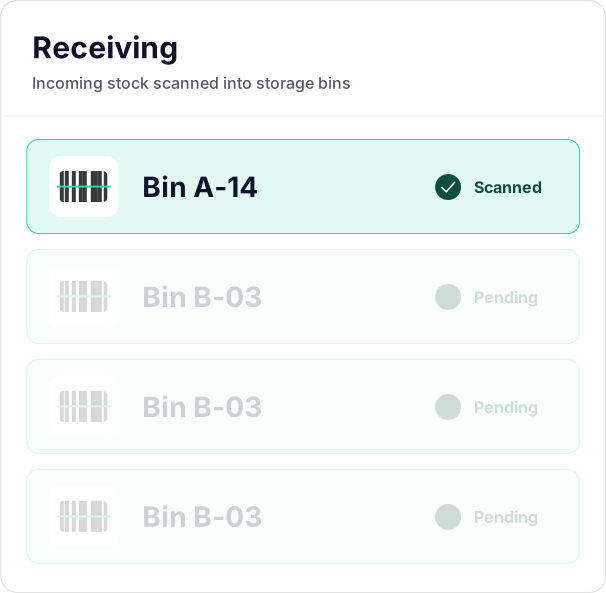
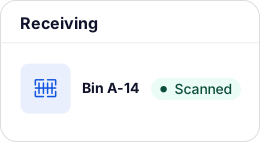
Goods in, scanned to a bin location
Receiving staff scan each item into a bin location on arrival, so the system always knows where stock is.
02
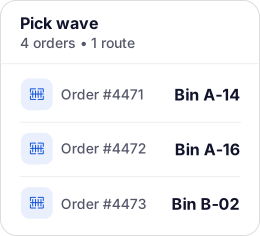
Orders group into pick waves
Linnworks consolidates same-location picks across all open orders and routes the picker in a single efficient pass.
03
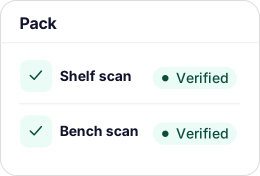
Pick and pack, barcode-verified
Scanning confirms the right item at the shelf and the right contents at the bench before anything is sealed.
04
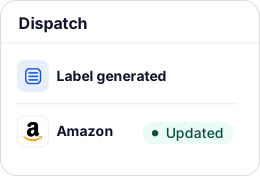
Dispatch and sync
The label prints, tracking pushes to the customer, and stock updates across every channel automatically.
What’s included in Linnworks warehouse management.
Pick & pack accuracy
Barcode scanning is enforced at pick and pack, so the wrong item can’t progress through either stage. Digital picklists run on any mobile device.
Wave picking
Consolidate same-location picks across all open orders and route pickers through the warehouse in one pass. No dedicated hardware required.
Zones, bins & locations
Configure your warehouse layout, and Linnworks routes stock and pickers to the right place automatically, tracking every movement from goods-in to dispatch.
Multichannel inventory accuracy
Every pick deducts stock and syncs to every channel before the next order lands. And multi-location tracking across warehouses, 3PLs, and dropshipping gives full visibility.
Kitting & bundling
Define bundles once, and pick lists show the components to pull. Stock deducts from the individual items automatically.
Connected to every channel and carrier you use.

What faster, more accurate fulfillment does for your brand.



“We achieved our multimillion-dollar revenue target in the first year. We simply couldn’t have achieved this with our old system.”
Read the case study

“With Linnworks, we’re able to have 100% data visibility and transparency, so we can identify where the inefficiencies are and drive the cost out of the system.”

Read the case study

“Linnworks is an essential partner as we scale our ecommerce operations to 15% of our overall business.”
Read the case study
Warehouse management FAQs.
Get answers to our most asked questions about our warehouse management software for ecommerce.
Warehouse management software (WMS) controls the physical movement of stock through a warehouse, from goods receipt and bin location assignment through to pick, pack, and dispatch. A WMS replaces paper-based processes with digital picklists, enforces accuracy through barcode scanning at pick and pack, and speeds up throughput through pick techniques like wave picking. For multichannel retailers, a WMS also needs to keep warehouse inventory in sync with every sales channel, so stock picked for one order is immediately reflected as unavailable on Amazon, eBay, Shopify, and every other channel simultaneously. Linnworks handles both layers in a single platform: warehouse operations and multichannel inventory are the same system, not two separate ones reconciled by a nightly sync.
Core things to look for in warehouse management software include barcode-enforced accuracy at both pick and pack, pick optimization like wave picking to ensure throughput does not slow as order volume grows, and real-time sync between warehouse activity and channel inventory.
Barcode scanning introduces a mandatory verification step at pick and pack for warehouse operations. In Linnworks, scanning works at three levels: item scanning confirms the correct SKU; bin location scanning confirms the item came from the correct shelf; and packing station scanning confirms the right items are going into the right box before it is sealed. Each checkpoint is independently configurable per workflow. The system will not register a pick or progress a pack until the correct scan is made. Manual override is available with system notation for damaged or missing barcodes, maintaining a full audit trail without blocking the workflow.
Wave picking groups open orders by pick location and routes pickers through the warehouse in a single consolidated pass, rather than picking one order at a time. Instead of walking the same aisle 15 times for 15 orders, a picker completes all picks for a location across all open orders in one pass before moving on. Items are assigned to labeled totes at the shelf, so the packing station already knows the contents of each tote on arrival. In Linnworks, wave picking runs on phones or tablets with no dedicated scanning hardware required, and pick waves can be assigned to individuals and tracked as they happen.
Yes. Linnworks provides a unified inventory view across all locations, such as owned warehouses, third-party 3PLs, and dropship suppliers, from a single dashboard. Inter-warehouse transfers are tracked from removal at origin through to receipt at destination, with availability updating on arrival. Orders can be routed to the nearest, cheapest, or most appropriate location automatically via the Rules Engine. 3PL integrations include ShipBob, CIRRO Fulfillment, and others; dispatch confirmations and tracking numbers flow back automatically. Adding a location is a configuration exercise, not a system rebuild.
A standalone WMS tracks stock movement inside the building. Linnworks tracks that and propagates every change to every sales channel. The critical difference is at the point of pick: inventory deducts the moment a pick is confirmed, not at dispatch, so channels update before the next sale happens. This eliminates the class of oversell that occurs when a WMS and a channel inventory platform run independently with a sync delay between them. A standalone WMS needs a separate integration layer to connect warehouse actions to channel stock; Linnworks removes that layer entirely.