
Order Management Software
Every order. Every channel. Dispatched without the friction.
When orders come from 10 channels, someone has to jump between 10 systems hundreds of times a day. Linnworks centralizes every order in one place, automating decisions so your team handles exceptions, not repetition.
Trusted by retailers worldwide


Every order routed automatically, at any volume.
As order volume grows, errors compound. A manual routing decision here, a missed carrier assignment there. By the time the errors are visible, they’re already affecting customers.
Order routing
Without automation, someone has to make routing decisions hundreds of times a day. Linnworks’ Rules Engine can route automatically based on your pre-set rules, before your team has to do extra legwork.
Order queues
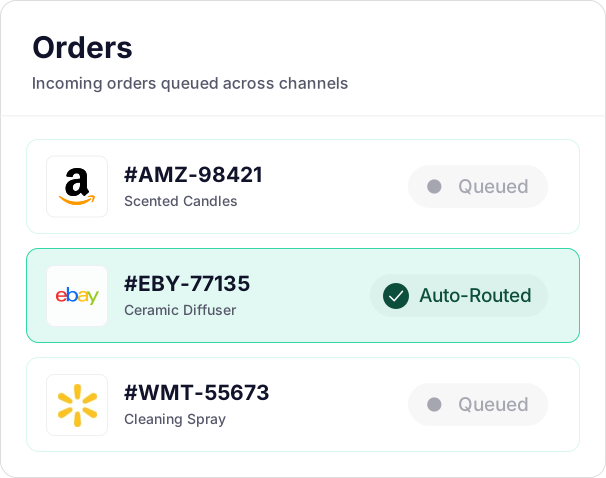
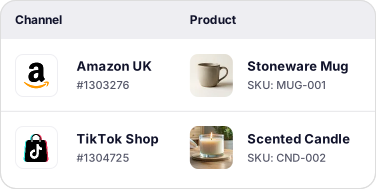
More channels usually means more queues to check and switch between. Linnworks unifies them into one pre-sorted view, so orders don’t fall through the gaps between channels.
Order processing
Order volume outpacing your team usually means hiring. Linnworks’ built-in AI and automation cut manual processing time by 20 to 50 hours a month instead.
How Linnworks order management works.
Here’s what happens from the moment an order is placed to the moment it ships.
01
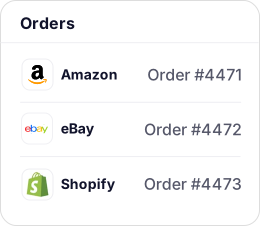
Orders download automatically from every channel
As orders land on Amazon, eBay, Shopify, Walmart, Temu, and your other channels, Linnworks pulls them into a single view. No switching between platforms. No manual imports.
02
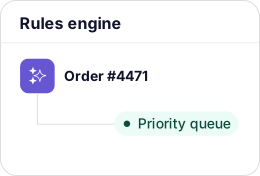
The Rules Engine sorts and routes them instantly
Before your team sees an order, Linnworks applies your automation rules. Prime order? Priority queue. International shipment? Routed to the correct carrier. AI will even tell you which manual decisions you repeat, and how to automate them.
03
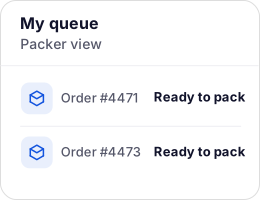
Your team focuses where it counts
Instead of making routing decisions on every order, your team sees a pre-sorted, pre-routed queue. And views are customized to teams: packers see what they need; the warehouse manager sees something different.
04
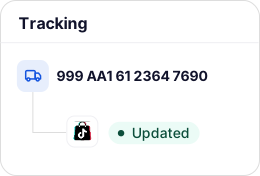
Tracking flows back to every channel automatically
Once an order ships, Linnworks logs the tracking and pushes it back to the originating channel. Customers get updates. Channels get confirmations. Your team sends nothing manually.
What’s included in Linnworks order management.
Unified order view
All orders from all channels on one screen. Configurable views let each user see exactly what’s relevant to them.
Intelligent automation
Build if/then automation rules to sort, route, tag, and stage orders based on any criteria you define. And get AI recommendations for new rules to automate your most manual actions.
Explore AI & automation
Order splitting and merging
Split multi-line orders to fulfill from different locations, merge orders from the same customer, and handle kits and bundles.
FBA, 3PL, and drop-ship routing
Route orders automatically to Amazon FBA, your 3PL, dropship vendors, or your own warehouse, based on rules you define.
Customizable order actions
Turn common multi-step actions into a single click: print a picking slip, assign a carrier, and advance the order from one configurable button.
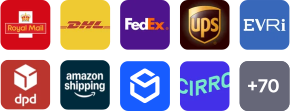
Connected to every channel and carrier you use.

Order management that scales with you.


“Once Linnworks came in, we started expanding to thousands of orders per day thanks to the uber-efficiency it allows for our business.”
Read the case study

“With Linnworks, we’re able to have 100% data visibility and transparency, so we can identify where the inefficiencies are and drive the cost out of the system.”

Read the case study

“Linnworks is an essential partner as we scale our ecommerce operations to 15% of our overall business.”
Read the case study
Order management FAQs.
Get answers to our most asked questions about our ecommerce order management software.
Multichannel order management software (OMS) centralizes orders from every sales channel: marketplaces like Amazon, eBay, and Walmart; D2C platforms like Shopify; and any other channel a retailer sells on. That means you have a single platform for processing, routing, and fulfillment. Without it, each channel has its own order queue, and teams move between platforms manually. As channel count and volume grow, the manual overhead compounds: missed carrier assignments, fulfillment delays, tracking updates that never reach the customer. Multichannel order management software removes most of that by treating every order the same way, regardless of source, routing it automatically, fulfilling it accurately, and pushing confirmation back to the originating channel.
Brands that successfully scale order volume without scaling their team start by automating repetitive decisions, like carrier selection, routing, and priority flagging. Homescapes, for example, used this approach to grow to 2,000+ orders each day. Order management stops being a bottleneck once routing and tracking updates happen automatically, instead of having to be manually entered for every order.
The Rules Engine is a no-code automation builder that processes every order before your team sees it. You define if/then logic based on any combination of order attributes: channel, weight, destination, SKU, order value, carrier, service level, or custom tags. When an order matches, Linnworks routes it, assigns a carrier, applies a flag, or stages it automatically. Rules can be layered and prioritized so specific conditions take precedence over general ones. Spotlight AI enhances this by monitoring manual actions and recommending the exact rules to automate them.
Yes. Linnworks supports blended fulfillment to route orders across your own warehouse, Amazon FBA, third-party 3PLs, and drop-ship vendors within the same workflow. A single order can be split across locations if line items ship from different places. Routing is automatic via the Rules Engine, based on product type, destination, channel, stock availability, or custom logic. Linnworks tracks each location’s status, receives tracking confirmations, and updates every channel accordingly.
As an ecommerce order management system, Linnworks is built for retailers processing thousands of orders per day, and processes 250M+ orders per year across its customer base. At volume, the Rules Engine automates carrier assignment, routing, tagging, and staging so throughput scales with volume rather than team size. Spotlight AI identifies where manual decisions are still happening and recommends automations. Customers report reducing manual processing time by 20–50 hours per month without increasing headcount using Spotlight AI with the Rules Engine.
When a tracking number is generated, Linnworks automatically pushes it back to the originating channel, whether that’s Amazon, eBay, Shopify, Walmart, TikTok Shop, or any other. The channel receives its fulfillment confirmation, and the customer receives their tracking notification, with no manual action from your team. For 3PL or FBA orders, tracking confirmation is received from the partner and logged in Linnworks, which then updates all connected channels.
Order management software handles what happens from the moment a sale is placed to the moment it ships: receiving the order, routing it to the right location, assigning a carrier, and pushing tracking back. Warehouse management software handles what happens inside the warehouse: where stock is, how it moves through pick-pack-dispatch, and how accuracy is maintained at the bench. The two overlap. A routing decision affects what the warehouse does, and a pick error creates a problem the order layer must resolve. Linnworks covers both, which is why customers describe it as the operational backbone of their fulfillment operation.