
Multichannel Selling
Sell on more channels. Run one operation.
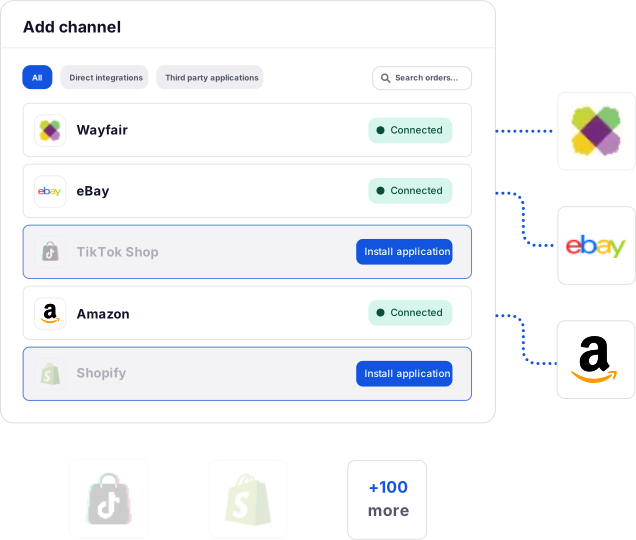
Every marketplace you’re not on is revenue sitting with a competitor. Linnworks connects your inventory, listings, and orders to 100+ channels, so expanding to Amazon, eBay, Walmart, TikTok Shop, or Temu doesn’t mean rebuilding your operation from scratch.
100+
native channel integrations
5 min
to add a new channel
Trusted by retailers worldwide


Expand channels without expanding the workload.
Every new marketplace is a growth opportunity. But managed manually, each one multiplies the work.
Channel launch time
Building listings, pricing, and shipping logic from scratch for each channel can consume weeks before a single order ships. Linnworks carries over existing rules, so you can launch quickly.
Channel operations
Without a central platform, five channels can mean five separate inventories, order queues, and reports to manage. Linnworks centralizes them into one dashboard.
Team growth
More channels usually means more orders, which usually means costly hiring. The Rules Engine and Spotlight AI automate processing decisions, so you can scale without adding headcount.
Grow your reach, not your workload.
Linnworks connects every channel, inventory source, and fulfillment process so you can expand without adding operational overhead.
Sell on 100+ channels, manage them like one
Adding a new marketplace shouldn’t mean rebuilding your operation. With Linnworks, it doesn’t. Inventory rules, pricing logic, and fulfillment routing all carry over to new channels automatically.
- 100+ native integrations, including Amazon, Shopify, eBay, Walmart, TikTok Shop, Temu, B&Q, WooCommerce, and Magento
- Add new channels fast, with existing rules carrying over automatically
- Set channel-specific pricing, availability buffers, and fulfillment rules from day one
- Access 300+ marketplaces worldwide through partners like Mirakl
List once. Publish everywhere. Update in one place.
Your product catalog is the foundation of every channel you sell on. Linnworks holds it centrally, with channel-specific attributes, pricing, and availability rules mapped per marketplace. A single change pushes to every connected channel simultaneously. No duplicate data entry. No inconsistent listings.
- Centralized product catalog with channel-specific attribute mapping
- Bulk listing creation and publishing across the world’s biggest channels simultaneously
- Price sync and promotional pricing across channels
- Automatic listing updates when product data, pricing, or availability changes
- Channel-specific titles, descriptions, and images from one catalog
Every channel. Accurate stock.
The reason most multichannel retailers oversell isn’t carelessness. It’s that their inventory system can’t keep up with their channels. Linnworks syncs stock across all connected marketplaces faster than most refresh themselves.
- Inventory deduction across all channels at the point of order
- Channel-level stock buffers can reserve inventory per marketplace
- Automatic listing suppression when stock hits your minimum threshold
- Composite and shadow SKU management for bundles and multi-condition stock
- Single source of truth: one inventory number, reflected everywhere
More channels. More orders. Same team.
Adding channels increases order volume. Order volume growth without automation increases headcount. Headcount growth erodes the margin that made expansion worth doing. Linnworks breaks that chain.
- Rules Engine: route orders by channel, weight, destination, SKU, or any custom criteria
- Spotlight AI: identifies manual tasks and recommends automation rules to remove them
- Automated carrier selection and label printing at dispatch
- Tracking number syncs back to all channels on dispatch automatically
- Blended fulfillment: route a single order across your own warehouse, 3PL, and dropship simultaneously
Know which channels are making you money.
When you’re selling across five channels, your P&L doesn’t tell you which three are profitable and which two are eroding margins on fees and returns. Linnworks does. Review performance by channel, SKU, or marketplace, with actual selling price (post-discount, post-fee) fed automatically into your reporting.
- Channel-by-channel revenue and margin reporting
- Best-selling and most profitable SKU views
- Actual selling price (post-discount, post-fee) passed to accounting and ERP
- Sales velocity and suggested reorder quantities per SKU
- Native Inventory Planner integration for demand forecasting
- QuickBooks, Xero, NetSuite, and Microsoft Business Central integrations















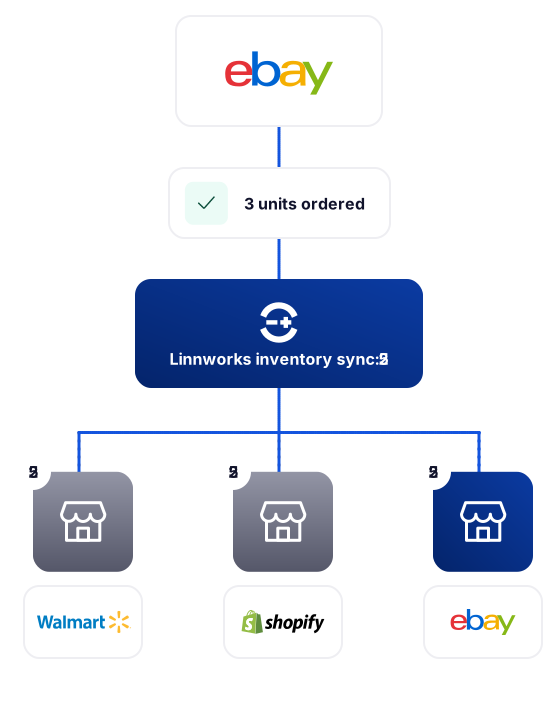
One order in, every channel updated.
Get an order from one channel, and stock updates across all your other marketplaces before the next sale comes in. No more oversells, no manual reconciliation.
What multichannel growth actually looks like with Linnworks.

“With Linnworks, we’re able to have 100% data visibility and transparency, so we can identify where the inefficiencies are and drive the cost out of the system.”

Read the case study

“Linnworks’ flexibility allowed us to connect to our 3PL partner & our couriers to provide automation to our orders. This has resulted in 98% of our orders passing from site to warehouse picker in less than 15 mins.”
Read the case study
Multichannel selling FAQs.
Explore answers to common questions about ecommerce automation across multiple sales channels.
Multichannel selling software connects a retailer’s product catalog, inventory, and order management to multiple sales channels: marketplaces like Amazon, eBay, and Walmart; D2C platforms like Shopify; and retail partners. Without it, each channel is managed separately: its own inventory count, its own order queue, its own listings. The result is manual reconciliation, inconsistent stock levels, and an operation that grows in complexity with every channel added. Multichannel selling software cuts that by centralizing everything. One inventory record serves every channel simultaneously, orders from all channels appear in one view, and listings can be created or updated once and pushed everywhere. Linnworks connects to 100+ channels natively, including Amazon, eBay, Walmart, Shopify, TikTok Shop, and Temu, and extends to 300+ marketplaces worldwide through our partners.
Adding a new marketplace in Linnworks typically takes minutes, not months. It is a configuration exercise, not a system rebuild or integration project. Your existing inventory rules, pricing logic, and fulfillment routing carry over to new channels automatically, so you’re not starting from scratch each time. The channel connection itself is usually free. Linnworks pricing is based on order volume rather than channel count, so expansion doesn’t create a cost surprise. Customers report that what used to be a weeks-long manual project of building listings, setting pricing rules, and configuring shipping logic now takes minutes. The Advantage Auto Parts team described adding a new channel as taking ‘5 minutes’ compared to the manual process.
Linnworks maintains a single central inventory record and pushes updates to every connected channel simultaneously. Every time an order lands on any channel, whether that’s Amazon, eBay, Shopify, Walmart, TikTok Shop, or any other, Linnworks immediately deducts the sold quantity from that central record and updates every other channel accordingly. Stock levels sync in under 10 minutes, which is faster than most marketplaces refresh their own data. Channel-level stock buffers allow you to reserve a portion of inventory per marketplace — so a buffer of 5 units on Amazon means Linnworks treats those units as unavailable on Amazon while keeping them available elsewhere. Automatic listing suppression takes a listing offline when stock hits your defined minimum threshold, preventing oversells even at the edges. Composite and shadow SKU support handles bundles and multi-condition stock within the same framework.
Linnworks connects natively to 100+ sales channels, including major marketplaces, D2C platforms, shipping carriers, 3PLs, ERPs, and analytics tools. Integrations include Amazon, eBay, Shopify, Walmart, TikTok Shop, Temu, Argos, B&Q, OnBuy, Fruugo, Back Market, WooCommerce, Magento, and many more. Through the Mirakl partnership and the broader Linnworks apps, access extends to 300+ marketplaces worldwide. Adding channels is typically free; Linnworks pricing is based on order volume, not channel count. For any channel not natively available, the partner network means a gap can be addressed without waiting for a native integration.
Not with the right automation in place. The risk with multichannel expansion is that order volume grows faster than your team can handle manually, leading to errors, delays, and eventually a hiring problem. Linnworks addresses this through two mechanisms. The Rules Engine lets you define routing logic once by channel, weight, destination, SKU, or any custom criteria, so every order is automatically sorted, routed, and staged before your team sees it. Spotlight AI goes further: it analyzes 90 days of your team’s actual processing behavior, identifies the manual decisions consuming the most time, and recommends the exact automation rules to eliminate them. Customers on Linnworks regularly scale from 2 to 10+ channels without increasing headcount because automation scales with order volume.
Without a centralized platform, multichannel selling almost always degrades inventory accuracy. Each channel maintains its own stock count, and those counts are reconciled manually. The gap between what a channel shows as available and what’s actually in the warehouse is where oversells, phantom stock, and order cancellations come from. Our data shows a single Amazon stockout can cost an average of $18,000 in lost revenue; a seven-day stockout can drop organic search ranking by 30–50%. With Linnworks, every channel draws from the same inventory record, updated at the point of order, nearly eliminating oversells.
Yes. Linnworks holds a centralized product catalog but allows channel-specific rules to be applied on top of it. Each channel can have its own pricing, listing titles and descriptions, availability buffers, and attribute mapping, all managed from one place and linked back to the same underlying product record. Promotional pricing can be set per channel and scheduled in advance. This means a product can have a different title on Amazon than on eBay, a different price on Walmart than on Shopify, and a different stock buffer per marketplace without maintaining them as separate catalog entries or logging into each platform separately to make changes.