
Linnworks vs. Sellercloud for multichannel sellers
Table of Contents

New commerce connects
Find out how Linnworks can help grow your business.

When shipping runs in one app, warehouse work in another, and orders in a third, every order has to pass between those apps before it leaves the building. Each handoff is a place an order can stall, and new hires have more than one app to learn.
Linnworks and Sellercloud both give multichannel sellers inventory, order, and warehouse management. But they’re set up differently.
Sellercloud, owned by Descartes Systems Group, runs its core platform in a web interface, prints most shipping labels in Shipbridge, a separate desktop app, and sells Skustack, a mobile warehouse management app, as a paid add-on.
Linnworks is a multichannel operations platform that runs orders, inventory, and shipping from one dashboard.
Linnworks demo: fully integrated fulfillment solutions
Streamline operations, enhance accuracy, and automate processes for better efficiency.

What’s the difference between Linnworks and Sellercloud?
| Linnworks | Sellercloud | |
|---|---|---|
| Channel integrations | 100+ marketplaces and channels | 150+ marketplace channels, within 350+ integrations in total |
| Shipping | 70+ shipping integrations, with labels, carrier assignment, and tracking in the core platform | Mainly Shipbridge, a separate desktop app, with 10+ shipping integrations listed, including aggregators |
| Warehouse management | Included in the core platform: bins and racks, digital picking and packing, a mobile scanning app, lot management, transfers, and replenishment | Warehouses and bins set up in the web app; bin-level picking, putaway, and audits run in Skustack, a paid add-on |
| Order automation | Rules Engine, with Spotlight AI recommending what to automate | Order rule engine |
| Pricing model | Quote-based, priced on order volume with no percentage fees | Starts at $1,349 a month on an annual plan, priced on order volume with no percentage fees |
| Ease of use on G2 | 7.8 out of 10 | 7.0 out of 10 |
| Ease of setup on G2 | 7.7 out of 10 | 6.1 out of 10 |
| Ease of admin on G2 | 8.0 out of 10 | 8.0 out of 10 |
| Quality of support on G2 | 8.2 out of 10 | 7.6 out of 10 |
How does shipping work in Linnworks and Sellercloud?
Most Sellercloud users print labels in Shipbridge, a desktop application that runs outside its main web interface, though the web interface can also generate labels. Shipbridge imports orders from your connected channels, can shop rates across carriers, and lets you set shipping rules based on package weight and other criteria.
In Linnworks, labels print from the same dashboard your team uses for orders and stock, and printing the label pushes tracking to the customer.
Linnworks connects directly to 70+ shipping providers and aggregators, including FedEx, Royal Mail, and ShipStation. The Rules Engine (an order automation tool) can pick a shipping service for each order based on criteria you set.
Carrier coverage was one of the deciding factors for Aspire Furniture, a UK wholesaler that specializes in beds and mattresses. Its previous system, Ordoro, was focused on the US market and integrated with US-based couriers. The team created and printed labels with each courier outside that system, then imported the tracking back in. Printing and labeling took two or three people every day.
By switching to Linnworks, anyone at Aspire who processes orders can print labels. Operations Director Ben Dobson said the business tripled its fulfillment rate with the same staff and saved “around 12 hours daily across stock management and order processing.”
How does warehouse management compare?
Sellercloud markets a full warehouse toolset: bin-level stock tracking, serial and lot tracking, and automated cycle counts. Warehouses and bins are set up in the main web app.
But in a bin-enabled warehouse, Sellercloud’s inventory movements have to run through Skustack, including picking, putaway, and physical audits. Skustack is a paid add-on that runs on Android handhelds with a desktop admin portal, and it can also be used on its own as a standalone warehouse management system (WMS).
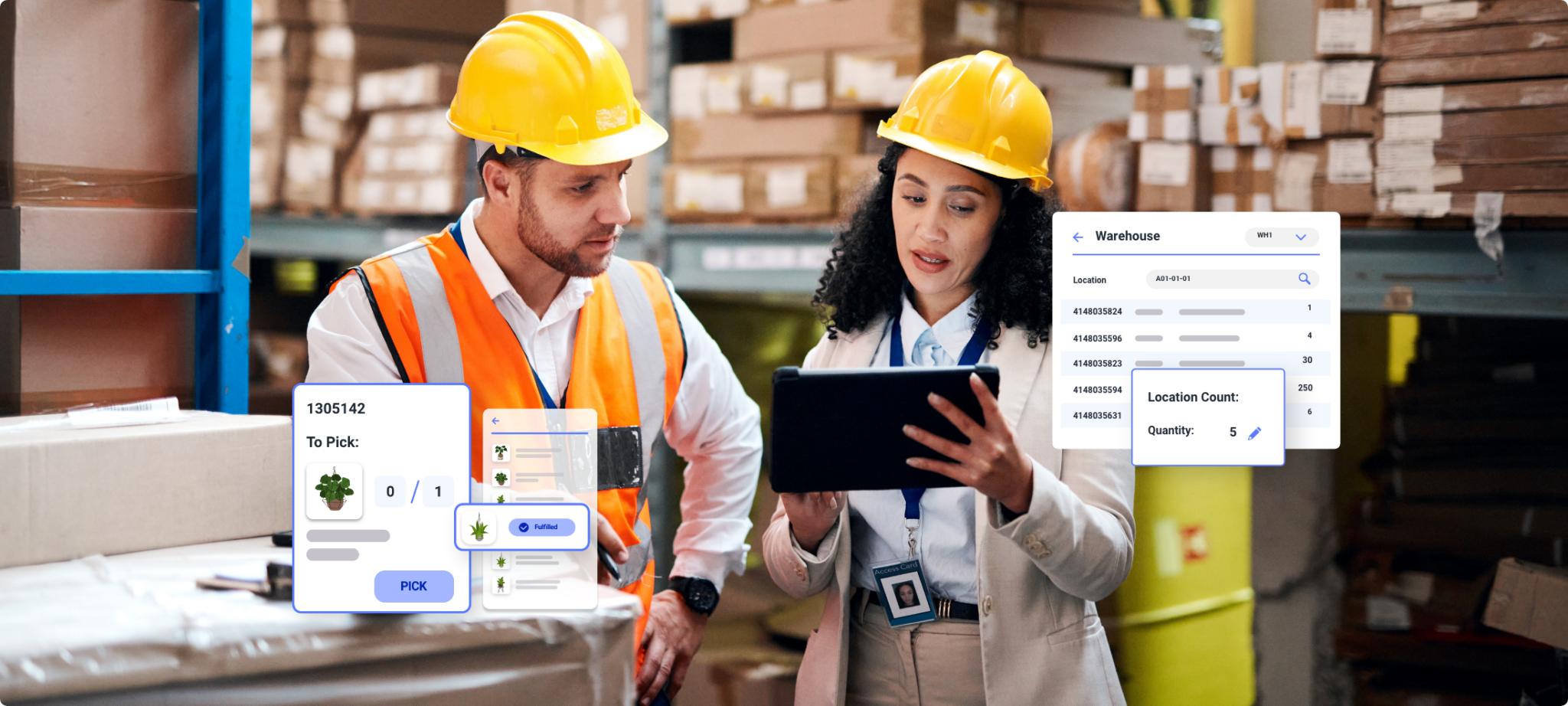
Linnworks’ warehouse management tools run in the same platform as orders and shipping. Picklists load on any mobile device, and stock deducts as soon as a pick is confirmed. Every connected channel picks up the new count within 10 minutes.
Wave picking (grouping open orders by pick location) lets a picker collect same-location items for several orders in one pass through the aisles.
Barcode scans confirm the item at the shelf, the bin it came from, and the contents at the packing station. You can require a check at pick and again at pack before the box is sealed.
Accurate stock counts also drive your automation. An order routing rule checks the count before sending the order to the right fulfillment center.
Inventory management savings calculator
Uncover the cost of your mis-ships, out of stocks and lack of labor efficiency with our inventory management savings calculator.
Why do separate systems make automation harder?
In Linnworks’ 2026 State of Commerce Operations report, a survey of 500 mid-market retailers in the US and UK, the most cited barriers to automating more of the operation were implementation cost, integration complexity across existing systems, and training requirements. Integration stood out: 46% of UK retailers called AI and automation integration a major operational challenge, and 44% of US retailers said the same of AI integration.
Retailers reporting flat or declining performance shared the same traits: limited integration between systems and continued reliance on manual processes.
About a third of retailers in both markets (34.0% UK, 34.4% US) named data accuracy and visibility across systems and partners as a fulfillment breaking point. Keeping shipping and warehouse work in the same platform as orders reduces both barriers. A new hire has fewer systems to learn, and your automation rules have fewer handoffs to work across.
How does order automation work in each platform?
Both platforms automate order handling with rules. But Spotlight AI tells Linnworks users which rules to build. It reviews how your team works inside the platform and flags the repetitive manual tasks costing the most hours, then recommends which Rules Engine automations to set up and how to configure them.
Sellercloud doesn’t offer an equivalent.
Our data shows online retailers average about 15,000 manual actions a month. Sellers who act on Spotlight AI’s recommendations save 52 hours a month on average.
Recommendations refresh weekly and cover jobs such as assigning shipping services and routing orders to the right warehouse. Spotlight AI comes built into Linnworks.
Which platform fits your operation?
Choose Sellercloud if you want unlimited users on your plan, a WMS that can also run on its own, or deep customization through plugins and EDI for complex, high-volume operations. G2 reviewers also report a 12-month return on investment from Sellercloud.
Choose Linnworks if you want shipping and warehouse work in the same dashboard as your orders, you want 70+ native shipping integrations rather than the 10+ Sellercloud lists, or you bring on temporary staff for peak and need them productive fast. G2 reviewers rate Linnworks 7.8 out of 10 for ease of use and 7.7 for ease of setup, against 7.0 and 6.1 for Sellercloud.
If your team is splitting work across separate shipping and warehouse apps today, bring that workflow to a demo. We’ll show you what it looks like in one dashboard. Linnworks can have you live in as little as 40 days, with dedicated onboarding specialists handling data migration and testing before go-live.
Get a Linnworks demo – automate inventory and orders faster
Book a Linnworks demo and see how it simplifies inventory, orders, and fulfillment. Get started today and optimize your eCommerce operations.

Linnworks vs. Sellercloud FAQs
What are the best Sellercloud alternatives?
Webgility and ShipStation top G2’s list of Sellercloud alternatives, and G2 also compares it directly with Veeqo and Linnworks. Which one fits depends on the part of the operation you’re replacing. ShipStation centers on shipping, Veeqo on inventory and shipping, and Webgility on syncing ecommerce orders with accounting software. If the friction is moving between Sellercloud, Skustack, and Shipbridge, Linnworks runs orders, inventory, and shipping in one dashboard, with warehouse management included in the core platform.
Is Descartes Sellercloud the same product as Sellercloud?
Yes. Descartes Systems Group acquired Sellercloud in October 2024 and now sells the platform as Descartes Sellercloud.
Does Sellercloud include shipping and warehouse management?
Yes. Core shipping and warehouse tools are part of the Sellercloud subscription. Most label printing runs in Shipbridge, a desktop app included with the plan, and Skustack, which bin-level warehouse work requires, costs extra. Linnworks keeps both in its core platform, with 70+ shipping integrations.