
How retailers can reduce shipping costs for ecommerce orders
Table of Contents

New commerce connects
Find out how Linnworks can help grow your business.

Shipping cost is set before anyone prints a label. The carton a picker grabbed, the service your rules assigned, the distance the parcel travels, and the rate you negotiated set the starting point for what you pay.
Which makes reducing shipping costs for ecommerce orders more complex than just negotiating on the rate card.
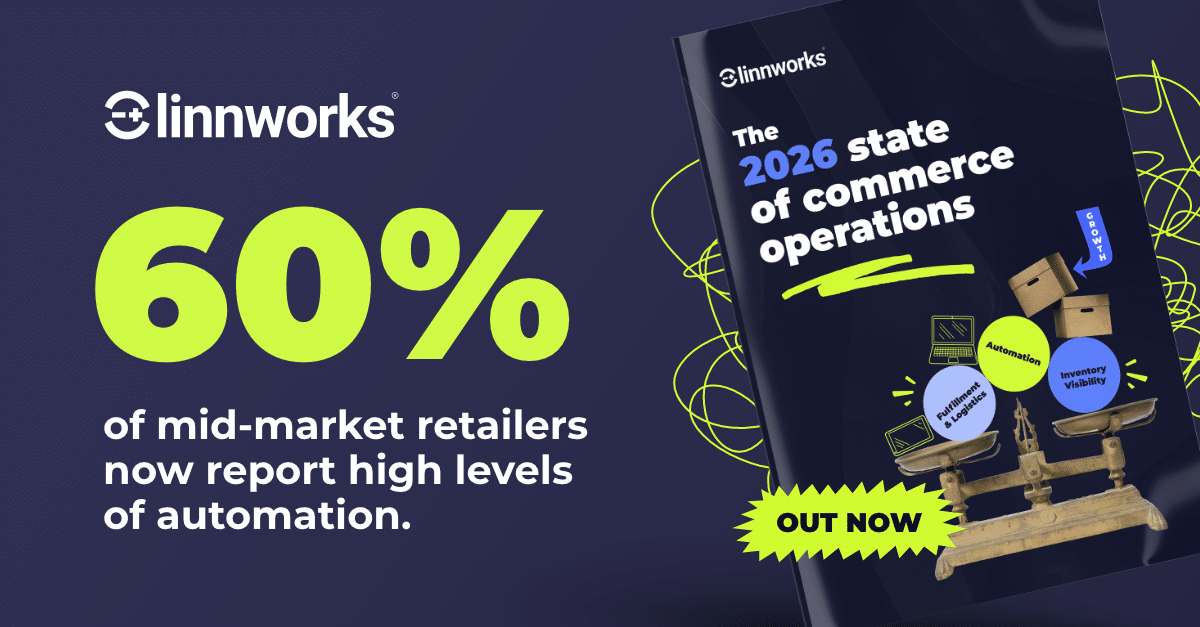
In the 2026 State of Commerce Operations report, around 40% of mid-market retailers named shipping cost inflation as a top logistics pressure. Managing delivery times came in just behind, and roughly a third of those retailers cited data accuracy across carriers and partners.
Here are seven ways any retailer can cut their shipping costs.
State of Commerce Ops Report
Insights from 200+ retailers on automation, inventory visibility, marketplace strategy and global growth.
Start with your cost per shipped order
Your cost per parcel includes packaging materials, the labor to pick and pack, and any surcharges the carrier applies on top of the base rate. Return postage counts too.
Pull 90 days of carrier invoices and packaging purchase orders and divide what you spent by the number of orders you shipped in the same window. It’s also helpful to do this by weight band and by channel.
Channel matters because the cost structures aren’t the same. A marketplace order carrying a delivery promise and a D2C order with free standard shipping give you different room to move.
If your marketplace parcels cost noticeably more per order than your own site’s, look at the service level your rules assign before you look at your rate card.
What’s on the carrier invoice
Surcharges move month to month and are billed per parcel:
- Fuel surcharge: a percentage of the base rate, reset on a published schedule.
- Residential delivery: applied to home addresses, which for a D2C seller is close to every parcel.
- Delivery area surcharge: added for rural and remote postcodes.
- Address correction: charged when the carrier has to repair an address you supplied.
- Additional handling: triggered by parcels past a size, girth, or weight threshold.
- Peak season surcharges: layered on from roughly October through January.
Most of these don’t appear in the quote your system shows at dispatch, so the cost you booked against the order is lower than the cost you’ll pay for it.
Two of them you can fix without going near the carrier. Address correction comes from bad address data, so validate at order download rather than disputing the charge after billing. Additional handling comes from a carton you chose.
Take one month of invoices, sum the charges by surcharge code, and sort them highest to lowest. Start with the two largest.
Don’t leave return shipping out of the math
Return postage is shipping spend, and it usually sits in a different report from the one your shipping cost lives in. Put them in the same report.
Log a reason code on every return, then look at the SKUs generating returns well above your catalog average. When one product is returning at several times the rate of everything around it, the fix is the listing photo, the size guide, or the packaging that let it arrive damaged. Nothing on the carrier side will touch it.
How box size sets your rate
Carriers weigh the parcel, calculate its dimensional weight (length times width times height, divided by a figure published in the carrier’s rate card), then bill on whichever number is higher. That figure can vary by carrier, region, and contract.
A light product in an oversized carton gets billed on the size of the carton.
Take your top 20 SKUs by shipped volume and check which box each one goes into at the bench. Trimming a carton by an inch on two sides can drop a parcel into a lower billable weight, and a smaller box needs less void fill.
Stop assigning shipping services by hand
Even with the right box, teams lose hours at the pack bench choosing between postal, parcel, and express services order by order.
Late in the day, before collections, the team at Dynergy would take a hundred errors at once and scramble to clear them.
Senior Operations Manager Narendra Tharwani put six to seven hours a week against that kind of work, and he was specific about where it concentrated: “most of our tasks were tied to assigning the right shipping service.”
When Dynergy started using Linnworks, manual actions dropped from roughly 3,700 a month to 78. That’s because Spotlight AI flagged which shipping services were repeatedly being selected for which packages and showed how to use the Rules Engine to automate those decisions. The team got back 28 hours a month.
Linnworks also pulls live quotes from dozens of supported carriers and aggregators for each order. Combined with the automated rules, retailers can save time and money.
Live quote retrieval isn’t available on every carrier integration, so check your providers before you design a workflow around it. Where a carrier doesn’t return quotes, route it on a static rule instead. Carrier rate cards separate most at weight breaks and by destination, so a rule built on those two conditions captures much of what live quoting would have found.
The Linnworks shipping and fulfillment report
Learn how ecommerce brands cut costs, improve delivery speed, optimize carriers and streamline operations.
One carrier is a rate problem and a peak-season problem
Retailers with fewer logistics disruptions in the 2026 State of Commerce Operations report were more likely to run multi-carrier setups with dynamic routing rules, use 3PLs to extend capacity, and coordinate orders, inventory, and carriers through one system rather than several.
Hughes, the UK’s largest domestic appliance renter, lost carrier capacity in the middle of a peak trading period when one of their external 3PL partners couldn’t handle the delivery volume.
With Linnworks, they were able to go live with a new carrier in seven days. Hughes had estimated 200-plus days to build their marketplace and courier integrations in-house before they moved the work into Linnworks.
With the right ecommerce platform, having a second carrier costs you an integration and some setup time to hold in reserve. What it buys is room when your primary carrier hits capacity during peak, plus the option to split traffic by lane and give each carrier the parcels it prices best.
Carriers price on volume, service mix, and zone mix, so a rep won’t rebuild a rate card for a few hundred parcels a week. Aggregators like EasyPost, Shippo, or Parcelhub give access to multiple carriers through one connection, and can sometimes offer better rates.
Ship from closer to the buyer
Ground parcel rates are zone-based. The same weight going three zones costs less than it does going seven, so a single warehouse in one corner of the country means a share of your orders pay top-zone rates on every parcel.
A second stocking location cuts those zones.
It also duplicates safety stock and raises carrying costs, and if the second node is a 3PL, you’re paying storage and pick fees on top of that.
The comparison to run is postage saved against stock duplicated.
Take last quarter’s orders, count what share landed in your two farthest zones, and price those same parcels from a candidate second origin. Annualize the difference.
On the other side, put the extra stock a second location makes you hold, plus storage and pick fees if it’s a 3PL. If the postage saving doesn’t clear that number, stay single-node and spend the effort on cartons and routing.
Where to start this week
The audit is a day of work: 90 days of carrier invoices sorted by surcharge code and by channel, next to your top 20 SKUs and the carton each one ships in. That gives you the two or three charges to attack and the SKUs going out in cartons too big for them.
Do that before you book the call with your carrier rep. And if the audit shows your team’s afternoons going into assigning shipping services order by order, automate that routing first, because it pays back in labor and postage at once. Linnworks connects to 70-plus carriers, aggregators, and 3PLs with that routing built in, so speak to our team to understand how automation can reduce shipping costs on your ecommerce orders.
Get a Linnworks demo – automate inventory and orders faster
Book a Linnworks demo and see how it simplifies inventory, orders, and fulfillment. Get started today and optimize your eCommerce operations.

FAQs
How often should you audit shipping costs?
Quarterly covers most operations, with an extra pass before peak surcharges start in the autumn. Fuel surcharges reset on a published schedule, and carriers revise accessorial charges at renewal, so a quarterly read catches a new charge before it has been billing you for six months.
Does offering free shipping increase your shipping costs?
It doesn’t change what the carrier bills you. It moves the cost out of the customer’s total and into your margin, which makes your threshold the lever rather than your rate card. Set the free-shipping threshold above your current average order value, so the orders that qualify are the ones carrying enough margin to absorb the postage.
What’s the difference between a shipping aggregator and a direct carrier integration?
A direct integration connects you to one carrier on the rates you hold with that carrier. An aggregator connects you to several carriers through a single connection, on rates the aggregator negotiated.
Direct integrations tend to win once your volume is large enough to negotiate your own rate card. Aggregators are the faster route into international lanes, or into a second carrier you don’t ship enough through to negotiate with directly.
Will moving to a 3PL reduce your shipping costs?
It can cut postage while adding cost elsewhere. Shipping from a location closer to your buyers reduces zones, and larger providers pass on carrier rates you couldn’t reach on your own volume.
Against that, you’re paying storage, receiving, and pick fees per order, and holding stock in a building you don’t control. Compare total cost per order, not the postage line.