Selling on B&Q Marketplace: A guide for home and garden brands
B&Q Marketplace lets sellers list products alongside B&Q’s own range on diy.com, one of the UK’s most visited home improvement destinations. Here’s what the marketplace is, who it suits, and how to get set up without adding operational strain.
Linnworks is the multichannel commerce platform that helps retailers grow sustainably. It connects operations across 100+ sales channels, bringing inventory, order, and warehouse management into one platform. More than 4,000 retailers run on Linnworks, processing $18B in GMV and 250M+ orders a year — because growth is never just a number.
B&Q Marketplace launched on diy.com in March 2022 with just four categories (wallpaper, lighting, power tools, and a new small domestic appliances range) and 17 founding sellers, including Black & Decker, Breville, and Osram. Products from verified sellers sit alongside B&Q’s own range in search results and listings, with a “Sold and shipped by [seller]” label so customers know who they’re buying from. Categories have expanded well beyond the launch lineup.
Tools, garden, lighting, storage, and furniture now sit alongside less obvious additions like cookware, tableware, TVs, sports and fitness, toys and games, and baby and nursery.
And more than 2,000 verified sellers are on the platform.
The marketplace runs on Mirakl’s platform. Sellers list on diy.com and handle their own fulfillment and customer service, while B&Q provides the storefront, payments, and the trust that comes with a brand that’s been around for over 50 years. Marketplace sellers also benefit from Click & Collect and in-store returns across 300 stores.
B&Q is part of the Kingfisher Group, alongside Screwfix, Castorama, Brico Dépôt, and OBI. Kingfisher is rolling out a single onboarding process that will give cross-border sellers access to all of its marketplaces at once, rather than applying to each separately.
For sellers in home, garden, and adjacent categories, B&Q Marketplace offers reach without the years of brand-building it would otherwise take to earn that customer trust. Around half of marketplace buyers are shopping with B&Q for the first time, so sellers gain access to a genuinely new customer base, not just an extension of B&Q’s existing one.
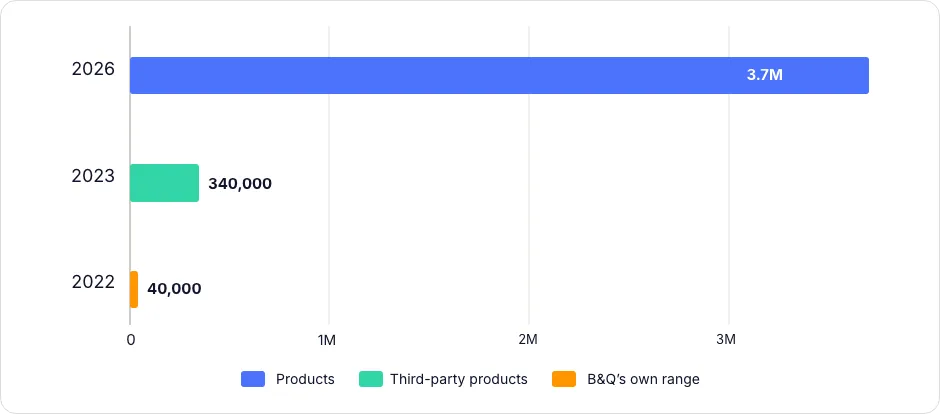
The growth has been fast. Merchants added more than 340,000 products in the marketplace’s first year.
By 2023, B&Q’s own five-year ambition was 2 million products and £500 million in marketplace sales. The marketplace has since passed £1 billion in sales since launch, with the most recent year alone up 44% to £445m.
Part of that growth comes from demand B&Q brings to the table directly. B&Q fully funds Google advertising that drives more than 15 million paid clicks a month to the site, including directly to marketplace product pages, at no extra cost to sellers. B&Q’s seasonal trading events matter too: sellers who took part in Black Friday saw sales grow five times faster than those who sat it out. Sellers who invest further in sponsored placements and retail media have seen even bigger gains, with adopters growing sales 44% against 22% for non-adopters, and the most committed sellers seeing a 15x uplift in sales value.
Sellers themselves back this up. Gtech, the UK vacuum and home appliance brand, saw sales up 20% year on year, more than double its first-year turnover target. Gtech describes the marketplace as giving it “access to a highly relevant and engaged customer base,” which it credits with a significant increase in reach and visibility. B&Q’s own team has said several sellers reported their B&Q revenue overtaking what they made on platforms they’d used for years, including Wayfair, eBay, and Amazon, within weeks.
Be able to dispatch within 2 days and deliver within 7
Respond to customer queries within 48 hours
Meet standard UK product safety rules
Be VAT-registered
Hold product liability insurance of at least £2 million
Pass B&Q’s standard business checks (covering credit, compliance, and identity verification)
B&Q also has a list of restricted items, which rules out things like disposable BBQs, certain chemicals, and age-restricted goods such as fireworks. And sellers of wood or paper products must work toward FSC or PEFC certification within 5 years of joining.
On geography: Kingfisher has recently started rolling out cross-border seller onboarding across its marketplaces, with approved sellers getting access as markets open.
B&Q has described its qualification requirements as a deliberate way to keep quality high. Even so, it encourages sellers who are unsure whether their range fits to apply anyway and have the conversation, rather than ruling themselves out early.
Selling on B&Q Marketplace has a simple cost structure: just a subscription and a commission on what actually sells.
The monthly subscription is a flat £39. The commission on each sale varies by category, generally between 8% and 15% (power tools sit at the lower end, most other categories at 15%), with a minimum commission of 25p per sale.
B&Q pays sellers every two weeks, with the subscription fee, commission, and any refunds deducted before payout.
Sellers manage inventory and fulfillment themselves, so don’t pay B&Q delivery or storage fees. But sellers must offer free delivery to the customer, so it’s worth building that into the product price when planning an expansion to B&Q Marketplace.
B&Q Marketplace asks more of sellers than a typical listings channel. In exchange for the brand’s reach and trust, sellers take on real operational responsibility, and it’s worth going in with eyes open about what that means day to day.
Shipping is entirely on the seller
There’s no B&Q warehouse network to fall back on: sellers ship every order themselves, and B&Q expects dispatch within 2 days and delivery within 7. This is exactly the strain Snowdon Timber faced, where large, awkward-to-ship timber products made delivery particularly hard to manage before automation.
Returns need a plan, especially for large items
Returns work the same way in reverse. B&Q’s returns policy for marketplace products mirrors its own 90-day window, and sellers cover the cost of return shipping. Bulky items add another wrinkle, since they aren’t eligible for in-store returns, so sellers of large products need a home-collection process worked out in advance rather than leaning on B&Q’s stores.
Getting on the marketplace isn’t automatic
B&Q reviews every application against what its customers expect, and has said it wants some friction in the process to protect quality, so sellers in less obvious categories may need to make a clearer case for fit. There’s also a detailed restricted items list that products need to clear before they can go live.
The bar doesn’t drop once you’re live
B&Q tracks sellers on things like on-time delivery, response times, and customer ratings, and can suspend sellers who fall well short or breach the rules, with counterfeit goods and taking transactions off-platform among the clearest examples of what gets sellers removed.
Another channel means another storefront to keep accurate
None of this is unusual for a marketplace of this size, but it does mean a seller is effectively running another small storefront: another set of stock levels, listings, and orders to keep accurate. Manual processes and disconnected systems are likely to fail.
Once you’re accepted onto B&Q Marketplace, the first practical question is how to connect it to everything else you sell. Since B&Q runs on Mirakl, one of Linnworks 100+ channel integrations, you can manage B&Q alongside every other marketplace you use.
You list your products once, and Linnworks pushes them live rather than making you rebuild them for every channel. When a customer buys something on B&Q (or anywhere else), your stock automatically updates everywhere you sell, so you’re not stuck manually adjusting quantities. And the order itself lands in the same dashboard as every other order you receive, so you pick, pack, and ship from one workflow instead of switching between separate systems
Behind the scenes, Linnworks’ Rules Engine automatically applies the decisions you’d otherwise make by hand, like which courier to use for a given order.
And Spotlight AI continuously monitors the manual tasks your team still performs and shows you how to automate the most costly ones.
As B&Q becomes a bigger part of your business, none of that changes: the same automation that worked for your first B&Q sale keeps working as order volume grows, without extra admin stacking up on top of it. Across all of Linnworks’ customers, that kind of automation now handles over 2.1 million decisions a day.
In a 2025 interview on selling through B&Q Marketplace, Lucas Christiano, then leading B&Q’s merchant account management team, described Linnworks as one of the most powerful and widely used integration platforms among B&Q’s merchants. He credited tools like it with bringing stock, orders, and pricing into one place, cutting out manual work, and giving merchants time back to focus on what they actually do best.
“Merchants can focus on what they actually do best.” — Lucas Christiano, B&Q, on the time saved by tools like Linnworks
The monthly subscription is a flat £39. The commission on each sale varies by category, generally between 8% and 15% (power tools sit at the lower end, most other categories at 15%), with a minimum commission of 25p per sale.
B&Q pays sellers every two weeks, with the subscription fee, commission, and any refunds deducted before payout.
Sellers manage inventory and fulfillment themselves, so don’t pay B&Q delivery or storage fees. But sellers must offer free delivery to the customer, so it’s worth building that into the product price when planning an expansion to B&Q Marketplace.
“Without centralized systems or automation, scaling further risked creating bottlenecks across warehouse and fulfillment. We saw Linnworks as a long-term solution that could support our growth across multiple channels.”
“Partnering with Linnworks has enabled us to future-proof our business operations. It’s helped us move from a reactive way of working to a model that’s scalable, controlled, and fit for purpose as we continue to grow.”
Explore answers to common questions about B&Q and Linnworks.
What do I need to qualify as a B&Q Marketplace seller?
Sellers need to be VAT-registered and able to fulfill orders themselves. You’ll also need product liability insurance of at least £2 million and to pass B&Q’s standard business checks.
How long does it take to get approved and start selling?
B&Q says sellers can be up and running in under five working days once approved.
How much does it cost to sell on B&Q Marketplace?
A £39 monthly subscription, plus a commission on each sale that varies by category, generally 8 to 15%, with a minimum of 25p.
How often do B&Q Marketplace sellers get paid?
Every two weeks, with the subscription fee, commission, and any refunds deducted before payout.
Who handles shipping on B&Q Marketplace?
The seller. Sellers arrange and pay for their own shipping and choose their own courier.
Can customers use Click & Collect on marketplace items?
Yes. Following a rollout across 300 B&Q stores, sellers can now give customers the option to collect marketplace orders in store. Customers can also return products in-store, an option that’s been available since the marketplace launched.
What’s B&Q’s returns policy for marketplace products?
It mirrors B&Q’s own 90-day window, with sellers covering the cost of return shipping. Bulky items aren’t eligible for in-store returns, so sellers of large products need a home-collection process in place.
What categories can I sell in on B&Q Marketplace?
Over 25 categories are open, spanning tools, garden, lighting, storage, and home furnishings, plus less obvious ones like cookware and camping equipment. Recent additions include electronics, sports and fitness, toys and games, and baby and nursery. B&Q has said it will consider other categories where there’s customer demand.
Is B&Q Marketplace only for home improvement brands?
No. While home and garden categories are the core fit, B&Q has expanded into categories like tableware, camping equipment, and plants, and has said it’s open to more.
Can international sellers join B&Q Marketplace?
B&Q Marketplace has been UK-only, though this is changing as Kingfisher rolls out cross-border onboarding across its marketplaces.