How to develop an ecommerce growth strategy that delivers
Table of Contents

New commerce connects
Find out how Linnworks can help grow your business.

Statistics show that 2.77 billion consumers will have completed at least one online purchase by the end of 2025, and that number is continuously rising. Ecommerce is no longer considered a niche channel, but a primary driver in modern retail.
For any ambitious ecommerce brand, this is a huge opportunity. But achieving improved profits requires a clear ecommerce growth strategy centered around building visibility, attracting the right customers, and scaling sustainably.
This guide breaks down what a strong growth strategy for ecommerce looks like, how to create one, and the specific tactics that deliver results.
From setting clear goals to optimizing your online presence, we’re here to break down the essentials. We’ll help you create a roadmap for growth, help you boost revenue, expand your customer base, deepen the customer experience, and take your business to new heights.
Let’s dive into the nitty-gritty of developing an ecommerce growth strategy that truly delivers.
| Just starting out? Read our blog on how to grow an ecommerce business first. |
Top 25 marketplaces to watch in 2025
Unlock the potential of marketplace strategy for 2025. Learn how to diversify and expand your online sales effectively.

What Is an Ecommerce Growth Strategy?
An ecommerce growth strategy is the master plan that propels your business from ‘just another online store’ to a dynamic, customer-focused titan.
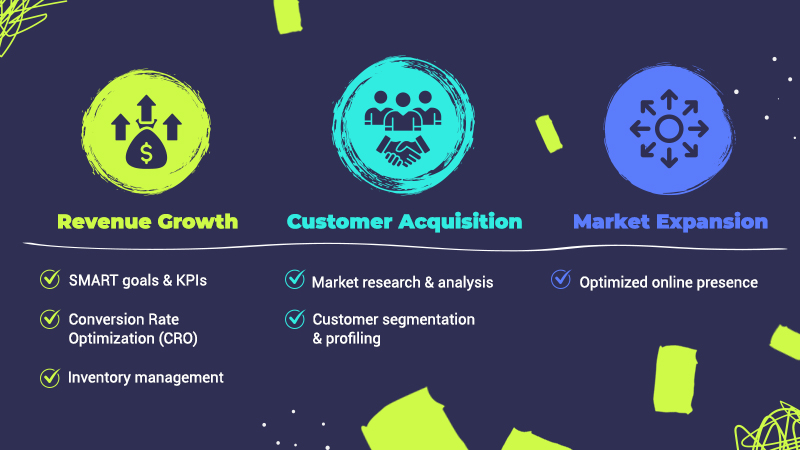
It focuses on three foundational areas:
- Revenue growth
- Customer acquisition
- Market expansion
These three foundational principles form a structured approach grounded in data, designed to help you make smarter decisions across marketing, operations, inventory, and experience.
To be effective, your growth strategy for ecommerce should include a blend of short-term ecommerce growth tactics (like bundling or upselling) and long-term initiatives (like SEO or brand building).
It should also align with your capabilities, audience needs, and infrastructure maturity.
As ecommerce becomes more competitive, businesses are also exploring connective ecommerce strategies — aligning platforms, partners, and data streams for cohesive, multi-channel growth.
All of these combined make for a well-defined ecommerce growth strategy that gives your business structure, but structure alone isn’t enough.
You need the right levers in place to activate that strategy and guide it toward tangible results.
In the sections that follow, we’ll break down the key elements of a successful ecommerce growth strategy, organized around the three pillars we introduced earlier: revenue growth, customer acquisition, and market expansion.
Key Elements of a Successful Ecommerce Growth Strategy
- Boosting Revenue Growth
Before you can scale operations or expand your customer base, you need to make sure your current channels are optimized for revenue.
This first pillar of your ecommerce growth strategy is all about getting more out of what you already have — increasing average order values, improving conversion rates, and unlocking profitability through smarter systems and better execution.
It’s the foundation that supports sustainable scaling. Read on to learn how to boost your revenue.
Set SMART Goals and Define KPIs
Every growth strategy starts with clear, measurable goals and KPIs. Vague aspirations like “sell more” won’t help you make decisions — but S.M.A.R.T (Specific, Measurable, Achievable, Relevant, and Time-bound) goals will.
Here’s an example of a S.M.A.R.T goal:
“Increase average order value by 15% in Q2 by introducing product bundles and free shipping thresholds.”
In this example, you know what measurable metric needs to be met (average order value by 15%), by when (Q2), and how to get there (introducing product bundles and free shipping thresholds).
To track progress more effectively, pair your goals with performance metrics.
These ecommerce KPIs can help reveal what’s working and where adjustments are needed:
- Average Order Value (AOV)
- Customer Lifetime Value (CLTV)
- Conversion Rate
- Revenue per Visitor (RPV)
- Cart Abandonment Rate
When reviewed consistently, these metrics serve as the compass for your ecommerce growth strategy, helping you fine-tune offers, experiences, and pricing models to drive profitability.
Optimize Your Online Presence
Think of your website as your primary sales rep. It should be fast, visually compelling, and simple to navigate — especially on mobile.
It’s estimated that this year, over 59% of global ecommerce sales are expected to come from mobile devices. If your site doesn’t perform across devices, you’re leaving revenue on the table.
Key areas to focus on:
- Responsive design: Your site should load fast and look sharp across all devices
- User experience (UX): Ensure intuitive navigation, clear CTAs, and minimal friction
- On-page SEO: Optimize headers, metadata, and images to improve search visibility. Also, incorporate consistent content marketing to attract high-intent traffic.
- Content quality: Regularly update pages and blogs so your ecommerce store stays fresh in Google’s index and delivers a seamless shopping experience
This is the foundation that supports every growth strategy for ecommerce — making it easier for customers to find you, trust you, and buy from you.
Leverage Conversion Rate Optimization (CRO)
Driving traffic is just half the battle. CRO helps you maximize the percentage of visitors who take action — whether it’s completing a purchase, joining your email marketing list, or downloading a lead magnet.
Tactics that support ecommerce growth include:
- A/B testing: Test versions of product pages, pricing structures, or CTAs to see what converts best
- Exit-intent popups: Capture abandoning visitors with last-minute offers
- Progressive forms: Reduce friction at checkout to increase completions
- Live chat or chatbots: Help customers in real time and remove hesitation
Remember, even small tweaks — like simplifying the checkout process or repositioning a CTA — can lead to big gains in conversion and, ultimately, revenue.
Related: 12 ecommerce growth hacks for 2025
Streamline Inventory Management for Profitability
Revenue growth also comes from managing costs and meeting demand efficiently. That’s why inventory management is a critical piece of your ecommerce growth strategy.
Well-managed inventory allows you to:
- Avoid stockouts that frustrate customers and cost you sales
- Reduce excess inventory that ties up capital and leads to discounting
- Improve fulfillment times and delivery reliability
Use inventory management software to:
- Track real-time stock levels across channels
- Forecast demand based on historical data and seasonality
- Automate reorder points to avoid manual errors
Platforms like Linnworks integrate inventory, orders, and fulfillment, giving you a clearer picture of what’s selling, what’s stalling, and how inventory affects customer satisfaction and profit.
While optimizing revenue is critical for growth, it’s just one part of the equation.
To sustain momentum, you also need to consistently attract and convert new customers — which brings us to the second pillar of your ecommerce growth strategy: customer acquisition.
Find your next marketplace quiz
Find your next ecommerce marketplace with this Interactive quiz. Expand to new audiences and new countries.

- Expanding Customer Acquisition
At its core, this pillar is about visibility and relevance: getting your brand in front of the right people, in the right place, at the right time — and making sure they stick around once they find you.
Conduct Market Research and Competitive Analysis
Before you can grow your customer base, you need to understand the landscape. What do your ideal customers want? What are your competitors doing — and more importantly, what are they missing?
Use tools like:
- Google Analytics to track traffic sources, bounce rates, and demographics
- Hotjar or VWO to see how users interact with your site
- Social listening tools to understand customer sentiment in your category
Additionally, send out short feedback surveys to past customers. What influenced their buying decision? What nearly stopped them?
This feedback is invaluable for refining product features, adjusting pricing strategies, and improving customer service. They also feed directly into your marketing strategy and product roadmap.
Understanding your position in the market is all about identifying meaningful opportunities to connect better with your target audience.
Segment and Profile Your Customers
Not all customers are created equal — and treating them like they are will kill your growth.
Effective customer segmentation allows you to deliver personalized messaging that resonates with specific types of buyers. You can segment by:
- Demographics: Age, location, gender
- Behavior: Purchase history, time-on-site, referral source
- Psychographics: Values, interests, lifestyle
Example personas:
- “Efficiency Ethan”: A small business owner looking for fast, streamlined tools to save time.
- “Value-driven Valerie”: A budget-conscious shopper who values reviews, comparisons, and loyalty perks.
Using CRM tools or ecommerce platforms like Klaviyo or HubSpot, you can create customer profiles that fuel automated campaigns and dynamic content.
By understanding your audience better, your ecommerce growth strategy can accurately drive conversions and improve your bottom line.
Execute Targeted Marketing Campaigns
Once you’ve identified and segmented your audience, you can run marketing campaigns that hit where it matters — emotionally, contextually, and financially.
Tactics include:
- Email flows: Onboarding sequences, abandoned cart emails, loyalty triggers
- Paid ads: Retargeting warm traffic on Meta or Google Display Network
- Influencer and affiliate marketing: Partner with voices your audience already trusts to amplify reach through social commerce and authentic endorsements
- Social proof tactics: Feature reviews, user-generated content, and customer photos across channels
Every channel should reinforce your core message and speak directly to the segment it’s targeting. Also, a balanced digital marketing mix—paid ads, email, and social—keeps acquisition costs predictable.
Now that you’ve laid the groundwork to bring in high-quality customers, the final pillar of your ecommerce growth strategy is about scaling that momentum — entering new markets, expanding product lines, and building strategic partnerships.
- Driving Market Expansion
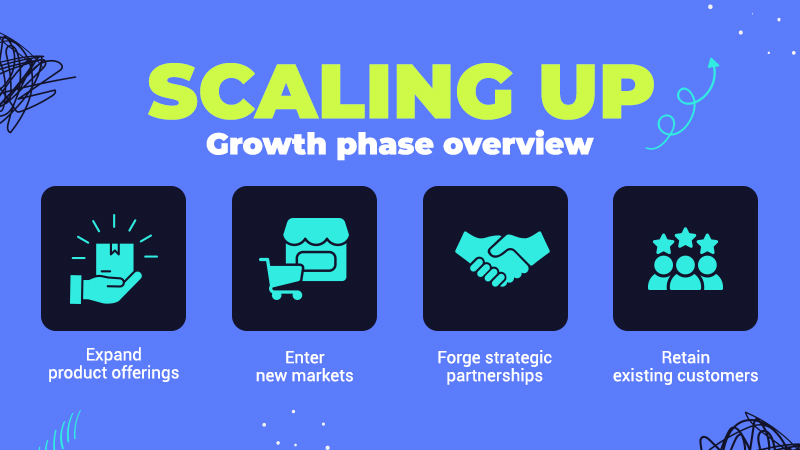
Once your store is generating consistent revenue and acquiring new customers, the next logical step is scale.
Driving market expansion means pushing beyond your existing audience, geography, or product lines — so your business continues to evolve.
Expand Your Product Lines
Adding new products — when done strategically — is one of the most effective ways to fuel ecommerce growth.
But it’s not just about adding variety for variety’s sake.
A smart product expansion should:
- Complement your existing catalog
- Address unmet needs from your current customer segments
- Open the door to cross-selling or bundling
Use purchase data, customer feedback, and seasonal trends to validate your decisions.
If a specific product type gets frequent cart views but low conversions, that’s a clue. Maybe it needs an alternate version (lower price point, different material, bundled offer).
Think of product line expansion as a diversification tactic within your broader ecommerce development strategy — one that reduces dependency on any single SKU and makes your store more resilient.
Enter New Geographical or Niche Markets
Scaling your ecommerce business globally — or even just regionally — can unlock powerful growth opportunities.
But it requires more than simply translating your homepage.
True localization involves:
- Adapting messaging, currency, and checkout flows
- Offering shipping options and delivery times that meet local expectations
- Understanding local purchasing behaviors, payment preferences, and regulations
Start by validating interest: Use tools like Google Trends or Meta Ads testing to assess regional demand.
You can also soft-launch into a region using international ecommerce platforms such as Amazon Global, Zalora, or eBay International. These platforms help streamline logistics, provide built-in audiences, and offer tools to simplify compliance — making them a great first step into cross-border ecommerce.
Entering a new market is an ambitious but rewarding move — and a crucial component of any growth strategy for ecommerce that aims to scale across borders.
Related: Beyond Ebay and Amazon: Growth opportunities on niche marketplaces
Form Strategic Partnerships and Collaborations
Sometimes, the fastest way to grow your footprint is to tap into another brand’s audience — ethically, of course. Strategic partnerships can unlock new ecommerce growth strategies without ballooning ad spend.
Effective ecommerce partnerships include:
- Influencers and creators: They offer immediate access to niche communities and lend social proof
- Complementary brands: Cross-promotions, co-branded bundles, or giveaways with aligned businesses (e.g. a skincare brand teaming with a makeup line)
- Tech partners: Apps, platforms, or agencies that enhance your offer (e.g. integrations with logistics providers or CRM tools)
These collaborations help reinforce your connective ecommerce strategy, making your brand part of a broader ecosystem rather than a siloed store.
Double Down on Customer Retention
Expanding into new markets and acquiring new customers is important — but retaining loyal customers is where long-term growth really compounds.
Research also shows that it’s 5–7× cheaper to nurture existing customers than to win new ones.
Retention strategies improve profitability by increasing the lifetime value of each customer, reducing your reliance on paid acquisition, and strengthening brand loyalty.
Tactics that drive retention include:
- Loyalty programs: Reward repeat purchases with points, perks, or exclusive access to strengthen customer loyalty and encourage repeat purchase
- Personalized experiences: Use past behavior to recommend products, remind customers to restock, or celebrate milestones like birthdays
- Email & SMS flows: Send well-timed follow-ups, re-engagement nudges, and win-back offers
- Exceptional customer support: Fast responses, generous return policies, and proactive service go a long way
- Referral marketing: Incentivize happy shoppers to bring friends and earn store credits
Your ecommerce growth strategy shouldn’t stop at first purchase. The more customers you retain, the stronger your foundation becomes — making each new market expansion more sustainable.
With your foundation in place, your customer engine humming, and your market reach expanding — the final step in your ecommerce growth strategy is optimization.
That’s where measurement, iteration, and continuous improvement come into play.
- Measuring and Analyzing Growth
A great ecommerce growth strategy doesn’t end with implementation — it continually evolves. That evolution starts with measurement.
Without tracking the right metrics, you’re essentially flying blind. But with clear visibility, you can optimize, scale, and future-proof your business, confidently.
Linnworks Demo: Streamline & Scale Your Ecommerce
Watch this demo of the Linnworks platform to gain end-to-end operational insights to forecast, plan, and scale your ecommerce businesss.

Use Tools That Turn Data into Insight
Modern ecommerce businesses are powered by data — but only if that data is accessible, understandable, and actionable.
Some of the most useful tools include:
- Google Analytics 4 (GA4): Understand how visitors move through your site, where they drop off, and what channels convert best. Leverage customer data from GA4 and your CRM to spot emerging buying patterns.
- Linnworks Reporting & Insights: Consolidate performance across inventory, sales channels, and fulfillment.
- Hotjar / Microsoft Clarity: Visualize user behavior with heatmaps and session recordings to spot friction points.
- CRM dashboards (e.g., Klaviyo, HubSpot): Track customer engagement across email, SMS, and purchase cycles.
These tools don’t just give you data — they help you understand why things are happening so you can respond effectively.
Make Data-Driven Decisions
Raw metrics won’t move the needle on their own. The power lies in how you interpret them and turn those insights into decisions.
Examples:
- Low mobile conversions? Check your site’s mobile UX and page speed.
- High CAC but low repeat purchases? Consider introducing a loyalty program or better post-purchase nurturing.
- One product consistently underperforming? Test repositioning, bundling, or discontinuing it altogether.
Look for patterns, test assumptions, and always be ready to pivot. Ecommerce is dynamic — your growth strategy should be too.
Related: Ecommerce analytics: How you can use data to help you scale
Review, Refine, Repeat
Growth isn’t linear — and your strategy shouldn’t be static. Establish a rhythm of regular reviews to revisit your goals, evaluate your tactics, and adapt to changes in market behavior.
Ask:
- Are our highest-intent channels getting enough budget?
- What content or campaigns drove the most efficient ROI?
- What’s changed in customer behavior in the past quarter?
Growth is about constantly doing better — and that only happens when you create space for review and continuous improvement.
Conclusion
A successful ecommerce growth strategy isn’t built overnight — it’s the result of clear goals, consistent execution, and continuous refinement. Whether you’re optimizing revenue, acquiring new customers, or expanding into new markets, each pillar of your strategy should work together to support scalable, sustainable growth.
But strategy only works when it’s paired with the right tools. That’s where Linnworks comes in.
By centralizing everything from inventory control to performance analytics, Linnworks helps you simplify operations, surface insights, and stay ahead of the curve — no matter how fast your business scales.
Ready to turn strategy into momentum?
Book a demo with Linnworks today and see how we can help power your next stage of ecommerce growth.